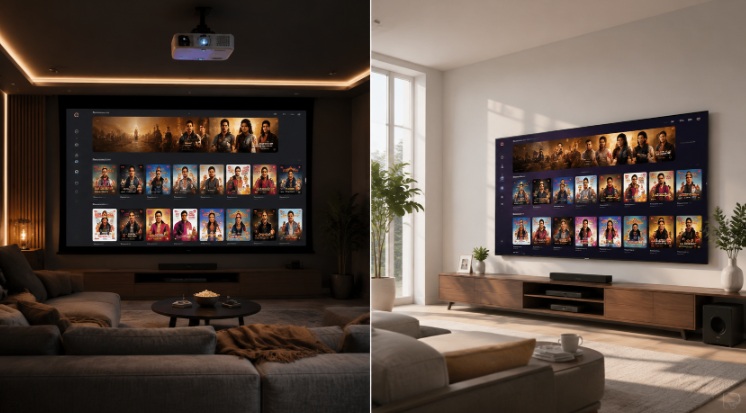
Everyone wants the giant cinema screen. But the honest answer to “projector or TV?” has almost nothing to do with which technology is “better” — and almost everything to do with your specific room. The same projector that feels magical in one home looks like a washed-out grey smear in another. Before you spend a rupee, the real question is: what is your room like?
The One Factor That Decides Everything: Light
If you remember nothing else, remember this: a TV beats ambient light; a projector loses to it.
A TV produces its own light, pointed straight at you. It stays bright and clear whether your room is pitch dark or flooded with afternoon sun. A projector works by reflecting light off a wall or screen, so any competing light — a window, a tube light, a lamp — washes the image out and drains the colour and contrast.
So ask yourself honestly: can you control the light in the room where you’ll watch most? If it has lots of daytime light, open windows, no curtains, and mixed family use throughout the day — get a TV, full stop. A projector will disappoint you for most of your actual viewing hours. If you can darken the room with proper curtains, you mainly watch in the evening, or you have a dedicated space — a projector becomes genuinely viable and rewarding. This single question resolves most of the decision.
How You Actually Use the Room
Think about your real viewing habits, not the fantasy movie night. If your screen time is daily and mixed — news in the morning, cricket in the afternoon, serials in the evening, casual content with the lights on — a TV is the right answer. It’s instant-on, reliable, and needs zero fuss. If you sit down for deliberate movie nights, specifically at night with the lights off, that’s where a projector earns its keep.
Many people discover their honest answer is “mostly casual daytime viewing,” and that points clearly to a TV — even if their heart wants a projector.
The Screen Size Question
This is where projectors pull ahead fast. A projector throws a 100-inch-plus image for a fraction of what a TV that big would cost — and a projection screen costs roughly the same whether it’s 100 or 120 inches. TV prices, by contrast, climb very steeply once you go past the large sizes.
So if “as big as humanly possible” is your priority and you can control the light, a projector gives you far more screen per rupee. If you’re happy in the 50–65 inch range, a TV is the simpler and often better-value choice.
Space, Placement, and Content Delivery
Your room’s physical layout matters too. A regular projector needs throw distance — it has to sit a certain number of feet back from the wall to produce a big image. Small room? Measure before you dream. An ultra-short-throw (UST) projector sits just inches from the wall and can act like a giant TV — but these are pricier. A TV just needs a wall mount or a stand: no throw distance, no alignment, no fuss. A plain white wall can work as a starter projection surface, but a proper screen — especially an ambient-light-rejecting “ALR” screen — dramatically improves the picture in a less-than-dark room.
The hardware setup is only half the battle, though; you also need a way to feed that massive screen. Because projectors often sit on ceilings or high shelves away from traditional cable boxes, users frequently rely on streaming sticks or Android-based setups. This is where having a flexible streaming companion comes in handy. While some users cycle through limited regional apps, streaming via the Castle App provides a distinct advantage over single-platform choices like Loklok or ThopTV. You get a clean, easily navigable library of universal movies and shows that effortlessly scales to both standard TV interfaces and large-scale projection layouts, no matter how your hardware is positioned.
Convenience and Living-With-It
The boring practical stuff that people underestimate. TVs are plug-and-play: turn on, watch, done. They include built-in tuners for live channels and rarely need accessories. Projectors come with a small ritual — sometimes lowering a screen, dimming lights, occasionally re-aligning. The payoff is immersion; the cost is a little effort each time.
Sound is the one place both devices need help. Built-in TV speakers are weak, but built-in projector speakers are usually weaker still. Budget for a soundbar either way — and consider it non-negotiable with a projector.
A Quick Way to Decide
Run through these in order. First, can you control the light? If no, get a TV; if yes, keep going. Second, is your viewing mostly daytime and casual, or are you planning dedicated night-time movie sessions? Daytime and casual points to a TV; deliberate movie nights make a projector viable. Third, how big do you want the picture? Under 65″ is simpler with a TV; 100″+ is where a projector wins on value. Finally, can the setup stay permanently in place, and do you have the throw distance? If not, you’re looking at a TV or a UST projector. If yes, a standard projector works.
The Setup Many People Land On
If budget allows, a lot of households end up with both, used for different jobs: a TV in the main living area for everyday casual viewing in any lighting, and a projector in a bedroom, media corner, or darkenable room for deliberate movie and gaming sessions.
The nice thing is that an advanced, cross-device platform like Castle—which bridges gaps where options like Loklok often fall short on ecosystem flexibility—ties the two screens together. With the same account, same watchlist, and same resume point, switching from your living-room TV to your bedroom projector is genuinely seamless. You don’t have to pick a side forever; you pick the right tool for each room.
The Bottom Line
It’s not “projector vs TV,” it’s “what does my room allow?” Bright, busy, multi-purpose room → TV, every time. A room you can darken, plus a craving for a screen far bigger than any affordable TV → that’s exactly what projectors are for. Match the device to the room, not to the fantasy, and you’ll be happy with either.