A warehouse can contain enough display area for a booking yet lack enough matching cabinets for its intended configuration. Total square meters conceal differences in size, pixel pitch and control arrangements. The inventory problem is therefore not merely how much equipment is owned, but which identified groups can fulfill each requirement.
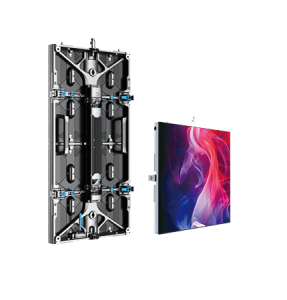
Standardization in LED video wall rental organizes those groups around a repeatable platform. A shared cabinet family creates common features without erasing the specifications that distinguish its members. For a creative LED display, the same distinction separates reusable equipment from an assumption that every item on the shelf belongs in every proposed wall.
Three Labels for Every Cabinet
A stock label identifies cabinet format, module dimensions and pixel pitch as separate fields. Format establishes the physical building unit; module dimensions identify the replaceable surface components; pitch identifies pixel spacing.
MEGA, manufactured by YES TECH, demonstrates why these labels remain separate even within a standardized rental display platform. A platform name alone describes none of those three attributes completely.
The MEGA cabinet measures 500 by 1000 by 86 mm and weighs 12.5 kg. It uses 250 by 500 mm modules, providing a consistent cabinet format for rental inventory planning. Their common module outline does not establish interchangeability across different pixel pitches or electrical configurations. In LED video wall rental records, cabinet dimensions therefore cannot stand in for image resolution.
MEGA offers three pixel-pitch options. The P3.91 version provides 128 by 256 pixels per cabinet, P4.63 provides 108 by 216 pixels, and P5.68 provides 88 by 176 pixels. A complete stock identity preserves the platform, physical format and pitch together, so equipment with similar external dimensions does not disappear into one undifferentiated quantity.
Allocating Stock by Screen Role
Main backdrops, side screens and background extensions draw on inventory for different physical outlines. A taller rectangular cabinet covers more vertical area per unit than the square version, reducing horizontal cabinet joints across the same vertical span. The two formats consequently represent different building increments within the same stock family.
MEGA cabinets connect horizontally or vertically, with concave and convex adjustment through ±10° in 2.5° steps. Those connection options give a creative LED display several possible roles for compatible equipment.
The inventory allocation follows the selected outline and configuration, rather than assigning a permanently exclusive cabinet family to every visual role. Stock allocated to a particular role retains its documented operating configuration.
Indoor and outdoor operation, together with IP65 protection, expands the documented application settings across concerts, festivals, exhibitions and press conferences. Brightness still varies with pitch: P3.91 and P4.63 offer 4000–5000 nits, while P5.68 offers 5000 nits.
A cabinet reassigned from a main backdrop to a side surface does not acquire a different brightness rating through its new location. Reuse means another suitable assignment for identified equipment, not removal of its configuration limits.
Common Procedures Across the Fleet
Training and maintenance contain repeatable actions that sit below the level of a complete event design. MEGA’s upper locating pins and magnets address alignment, its middle fast lock addresses connection, and its lower automatic latch completes the lower interface.
Those recurring mechanisms supply common subject matter across assignments within the platform. Transport and support hardware add further common procedures: the touring dolly carries 12 panels, and the beam arrangement serves hanging and stacking.
Module replacement from either the front or rear and whole-unit control-box exchange establish recurring service categories. For LED video wall rental operations, a maintenance record can distinguish the affected module from the control assembly instead of treating each fault as an unspecified cabinet problem. Replacement compatibility still follows the actual equipment configuration.
Familiar support hardware does not equate hanging and stacking installation conditions. Standardization concentrates repeatable handling and service knowledge around recognizable equipment while preserving configuration-specific work.
Any reduction in training effort or spare-stock cost would depend on the company’s existing inventory and deployment pattern; the shared mechanisms describe the basis for repetition, not a measured saving already achieved by a rental company.
Exceptions That Belong in the Stock Record
A standardized platform still contains choices that affect preparation. Indoor and outdoor operation, together with IP65 protection, expands the documented application settings across concerts, festivals, exhibitions and press conferences. Brightness still varies with pitch: P3.91 and P4.63 offer 4000–5000 nits, while P5.68 offers 5000 nits. Shared specifications coexist with options, so a record of the actual supplied configuration remains more informative than a series name alone.
CE, FCC and ETL are the listed certification designations. Documentation associated with the supplied equipment provides a separate verification category from cabinet dimensions or operating settings.
For a creative LED display, inventory identity also connects a proposed assignment with the modules, control arrangement and physical formats available to support that assignment. Preserved differences make a standardized fleet understandable rather than fragmented.
Common connection and service procedures can recur while pitch, native resolution, cabinet mass and control options stay attached to the relevant units. The resulting inventory structure describes both the available equipment and the combinations requiring confirmation for a job.
Rental companies gain a coherent basis for allocating a platform across screen roles, with predictable preparation rooted in identifiable configurations rather than an unsupported promise that every cabinet and spare can replace every other.