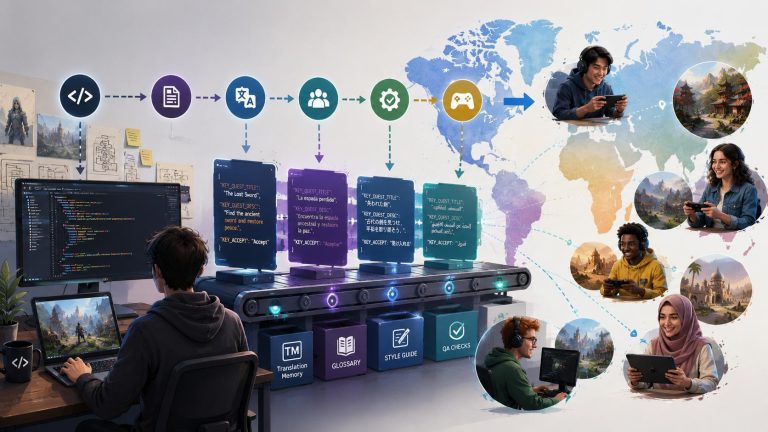
TL;DR: Scalable game localization requires two parallel disciplines. On the engineering side, teams externalize strings, implement locale-aware formatting, support text expansion and right-to-left scripts, and build pipelines that push translations through continuous integration. On the cultural side, teams adapt symbols, humor, gestures, and narrative beats to fit target markets without breaking the game’s identity. Studios that treat only one side ship products that fail internationally regardless of budget.
Global game releases in 2026 look nothing like they did a decade ago. Where AAA studios once localized into five or six major languages as a post-launch afterthought, most successful releases now ship day-one in fifteen to twenty locales, with continuous localization workflows that keep every version synchronized as the game evolves. This shift has been driven by economic reality (international revenue often exceeds domestic revenue for successful titles) and technical maturity in the tooling that makes multi-language releases possible at reasonable cost.
The studios that succeed at this scale treat localization as a two-layer engineering problem. The first layer is code — the infrastructure that separates language from logic, externalizes strings, supports multiple scripts and formatting conventions, and integrates with translation platforms through automated pipelines. The second layer is culture — the linguistic, symbolic, and narrative adaptations that turn a game translated into Japanese into a game that Japanese players actually enjoy. Neither layer alone is enough.
This article walks through how modern studios engineer localization systems that handle both layers at scale, the pipeline design that connects them, and the failure modes that repeatedly derail studios attempting global releases without a mature localization program. For teams looking for an end-to-end operational reference that complements the strategic frame here, Crowdin’s game localization guide covers the file formats, engine integrations, and workflow patterns in step-by-step detail — a useful companion for anyone building their first serious pipeline or auditing an established program.
The Engineering Foundation: Making Games Localizable at the Code Level
Before a single word can be translated, the game itself must be architected to support localization. This preparation work — often called internationalization (i18n) — happens in engineering long before any translator joins the project. Studios that skip it discover the cost during their first international release, when retrofitting i18n into a mature codebase becomes a multi-month project that competes with everything else on the roadmap.
The core engineering practices for localization-ready games include:
- Externalized strings: Every user-facing text lives in resource files (Unity .po files, Unreal .csv, JSON, YAML, engine-specific formats), never hardcoded in scripts or dialogue nodes
- Stable string identifiers: Each string has a key that persists across releases, so translation memory can match across game updates
- Locale-aware formatting: Numbers, dates, currencies, and pluralization use libraries that understand locale conventions rather than hardcoded patterns
- Font and script support: The rendering pipeline handles CJK characters, right-to-left scripts (Arabic, Hebrew), diacritics, and combining characters without visual breakage
- Text expansion tolerance: UI layouts accommodate up to 40 percent text growth for languages like German or Finnish
- Placeholder safety: Dynamic content like {playerName}or {itemCount} is protected through structured templates that survive translation
Modern game engines (Unity, Unreal, Godot) provide native or first-party plugin support for most of these patterns. The engineering discipline is knowing which patterns to enforce and building lint rules that catch violations before they land in production. Studios that pseudo-localize their builds throughout development — replacing English strings with expanded fake translations containing accented characters — catch layout and rendering bugs before real translation begins.
The Cultural Layer: Beyond Translation
Once the engineering foundation is in place, the harder work begins: making the game actually feel native to each target audience. This is where translation stops being sufficient and culturalization takes over.
Culturalization operates on several dimensions:
- Linguistic adaptation: Translators localize dialogue, item names, and lore to sound natural — not just accurate — in the target language. Puns, wordplay, and cultural references get replaced with equivalents that make sense to native speakers.
- Symbolic adaptation: Symbols, colors, gestures, and imagery that carry meaning in one culture may carry different meaning in another. Red crosses become neutral crosses. Certain hand gestures get removed or replaced. Colors associated with mourning in one region may need adjustment.
- Narrative adaptation: Character names, place names, historical references, and plot elements may need adjustment to avoid unintended offense or confusion in specific markets.
- Regulatory adaptation: Age rating boards (ESRB, PEGI, CERO, USK) and content restrictions in specific markets (China’s approval process, Germany’s imagery restrictions, Middle Eastern content guidelines) all shape what can and cannot ship in a given region.
- UX cultural fit: Interface expectations vary — Japanese players often expect denser UI with more information per screen, while Western players expect cleaner, sparser layouts.
The studios that do culturalization well involve native-speaking consultants and players from each target market during development, not as a post-launch QA pass. A cultural review of the localized build in each market catches issues while they are still cheap to fix. Culturalization that arrives after launch produces the viral controversies that damage a game’s reception in specific regions for years.
Building the Pipeline for Scale
Engineering foundations and cultural adaptation come together in a continuous localization pipeline. In a mature setup, a developer commits a new dialogue line to the source repository. A webhook notifies the translation platform, which pulls the updated strings and identifies new or changed segments. Translation memory matches similar past strings; machine translation drafts the rest; human translators refine the output in context; culturalization consultants review high-stakes content; and approved translations flow back into the source repository as a pull request that ships in the next build.
The specific pipeline design varies by studio size and game type. Indie teams with small text volumes may operate manually with a lightweight tool. AAA studios with hundreds of thousands of words across multiple languages need full continuous integration between the game engine, the translation platform, the voice recording infrastructure, and the QA systems. What separates working pipelines from broken ones is not technology — it is the discipline of treating localization as continuous engineering rather than a launch-week project.
Key components of a scalable pipeline:
- Version control integration (Git, Perforce) with automated webhook triggers
- File format parsers for the game engine’s native localization format
- Translation memory and glossary as compounding assets
- In-context editing tools that show translators the actual game UI
- Automated quality checks for placeholders, tags, and length constraints
- Human review workflows scoped by content sensitivity
- Voice-over recording integration for spoken content
- Linguistic Quality Assurance as a mandatory pre-release phase
Common Failure Modes That Sink International Releases
Even studios that build sophisticated pipelines often fail on a few recurring mistakes.
The first is treating localization as a downstream task rather than a parallel workflow. Studios that finish English content and then hand it off for translation weeks before launch consistently ship broken international versions. Successful teams begin localization work as soon as English content stabilizes for a given feature.
The second is providing translators no context. A translator working from a flat list of strings — without seeing which character speaks each line, when it appears in the game, or what visual context surrounds it — cannot produce quality translations for narrative content. The solution is in-context editing tools, screenshots, and ideally playable builds for translators.
The third is skipping cultural review. Machine translation and even professional linguistic translation can miss cultural landmines that only native players from the target market recognize. Native-speaking cultural consultants remain essential for narrative-heavy games.
The fourth is under-investing in Linguistic Quality Assurance. Studios that translate the game but never test the localized build catch launch-day bugs from angry player reviews rather than from internal QA. Even a two-week LQA pass on the main story arc catches the majority of high-severity issues.
Frequently Asked Questions
What is the difference between game translation and game localization?
Translation is the conversion of text from one language to another. Localization is the broader adaptation of the entire game — text, UI, audio, cultural references, regulatory compliance — for a specific market. Every game localization project includes translation, but not every translation project is a complete localization.
How early should game localization begin in the development cycle?
Ideally, during pre-production. Externalizing strings, choosing file formats, and building the translation pipeline should be architectural decisions made before feature development begins. Retrofitting localization into a mature codebase is significantly more expensive than building it in from day one.
Which languages should indie studios prioritize for their first international release?
The five languages with consistently strong ROI for indie games are Simplified Chinese, Brazilian Portuguese, Latin American Spanish, Russian, and German. These markets have large gaming populations and consistently reward localized content with higher wishlist rates and stronger post-launch retention.
Can AI translation handle game localization on its own?
Not for narrative content. AI translation has improved dramatically and handles routine content — UI strings, help articles, item descriptions — with high accuracy. Character dialogue, emotional beats, and culturally sensitive material still benefit substantially from human translators and cultural consultants. The dominant model in 2026 is AI-first drafting with human refinement on story content.
How much does game localization typically cost?
Costs vary widely by scope. Indie games with 30,000-50,000 words across five languages typically budget $5,000 to $30,000 per language for text-only localization. AAA titles with full voice-over across ten or more languages can reach $150,000 to $2 million per language. Machine translation with post-editing significantly reduces costs for high-volume routine content.
What is Linguistic Quality Assurance (LQA) in games?
LQA is the process of playing through the localized build to catch translation errors, formatting issues, context bugs, and cultural adaptations that fail in-game. Native-speaking testers play the game in each supported language and file bugs against the localized version. LQA is the last line of defense before international players see the game.
How do studios manage voice-over across many languages?
Voice-over is the most expensive layer of game localization and requires parallel scheduling to text translation. Casting, recording, mixing, and lip-sync integration should begin as early as text localization to avoid a launch-week bottleneck. Studios typically outsource voice production to regional recording studios that specialize in game audio.
Conclusion
Scalable game localization is a discipline that sits at the intersection of engineering rigor and cultural sensitivity. The studios producing consistently successful international releases in 2026 have built systems that treat both layers as engineering problems — externalized strings, continuous pipelines, translation memory, cultural review, and LQA as mandatory phases in the release cycle. The teams that succeed do not treat localization as a bolt-on. They treat it as infrastructure — and that discipline compounds over years into a durable competitive advantage in global markets.