The table often becomes the visual and functional center of a professional meeting space, yet not every table serves the same purpose. Conference room furniture is generally selected around the scale, formality, technology, and collaborative requirements of the room rather than simply its appearance. Leadcom seating can be considered alongside the table, but the distinction between a conference table and a standard meeting table begins with how the space is expected to operate.
Purpose And Room Function
A conference room is commonly designed for formal discussions, presentations, negotiations, or executive decision-making. Its central table usually needs to accommodate longer sessions, multiple participants, presentation equipment, and clear sightlines. A standard meeting room may instead support quick team discussions, smaller project groups, or informal exchanges.
This difference influences dimensions and placement. Larger rooms can accommodate broader table surfaces and more generous circulation zones, whereas compact meeting spaces benefit from proportions that preserve usable floor area. The table should therefore correspond to the room’s intended activity instead of being selected solely according to the number of available seats.
The practical role of conference room furniture becomes clearer when the room’s purpose is established before individual pieces are specified.
Table Size And Participant Spacing
A conference table generally provides more individual workspace because participants may need laptops, documents, notebooks, or presentation materials simultaneously. Sufficient depth also creates a visual boundary between participants without making communication feel distant.
Standard meeting tables can be smaller, particularly where discussions are brief or where furniture needs to be rearranged regularly. Regardless of the format, each person needs enough elbow room to work comfortably and move a chair without disturbing neighboring users.
Thoughtful spacing matters just as much as the tabletop itself. A room that technically fits a large table may become inconvenient if chair clearance and walking routes are sacrificed.
Construction And Material Considerations
Durability becomes particularly relevant in meeting environments used throughout the working day. Tabletop materials must withstand repeated contact with laptops, writing materials, beverage containers, and routine cleaning. Structural components also influence stability, especially when larger surfaces require stronger support.
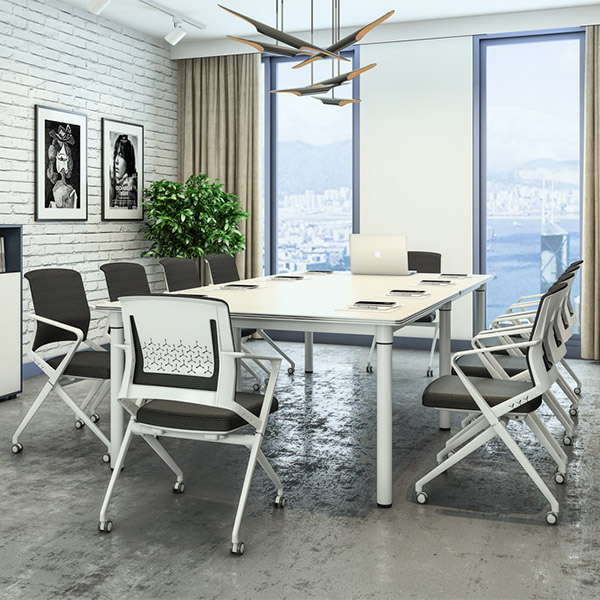
The HARRIS LS-418ST illustrates one approach with a 25 mm-thick E0-grade particle-board tabletop and melamine finish. Its structure incorporates a 1.8 mm aluminum column with a baking-varnish finish, a 50 × 25 × 1.5 mm cold-rolled steel beam, and PP glides. Such specifications show how tabletop thickness and supporting components can be considered together rather than evaluated separately.
Material selection gives conference room furniture a direct connection to maintenance expectations, daily usage, and the physical demands of the workplace.
Technology And Cable Access
Modern meetings rarely depend on a tabletop alone. Video conferencing cameras, charging devices, displays, microphones, and laptops can all affect how the table should be positioned. A conventional table may require additional cable-management accessories, while a purpose-designed meeting environment can incorporate technology more deliberately.
Screen visibility is another factor. Participants should have a clear view without excessive twisting or leaning, particularly during presentations or hybrid meetings. Power access should remain convenient while cables stay away from primary circulation routes.
A successful conference layout treats technology as part of the spatial plan rather than an accessory added after installation.
Fixed Tables And Flexible Configurations
A fixed table works well when the room has a stable purpose and a consistent participant arrangement. It can create a defined central workspace and reduce the need for frequent repositioning. This approach is often appropriate for formal conference rooms where the furniture layout remains largely unchanged.
Flexible tables have greater value in rooms that alternate between workshops, training sessions, group discussions, and presentations. Folding or movable designs can free floor space when the room needs to serve several functions. The choice therefore depends on how frequently the environment changes rather than on whether flexibility sounds attractive in theory.
For larger permanent settings, Leadcom seating can be coordinated with a fixed tabletop arrangement to create consistent spacing and predictable circulation.
Seating, Movement, And Overall Layout
The relationship between the table and chairs should be examined from several directions. Participants need sufficient clearance to pull out a seat, sit down, leave the room, and move toward presentation equipment. Doorways, storage cabinets, and emergency routes should remain accessible even when every seat is occupied.
Chair dimensions also affect the effective footprint of the table. A compact tabletop paired with oversized seating may consume more floor space than expected, while excessively narrow seating positions can make long meetings uncomfortable. The most efficient arrangement is therefore not necessarily the one with the greatest number of seats.
Good conference room furniture planning connects the table, seating, circulation, and technology into one spatial system instead of treating them as unrelated purchases.
Conclusion
The distinction between a conference room table and a standard meeting table is ultimately rooted in function. Formal conference spaces often demand greater surface area, stronger structural planning, clearer technology integration, and more deliberate participant spacing. Smaller meeting rooms may place greater value on compact dimensions or reconfigurability.
Material specifications, room proportions, circulation requirements, and expected meeting behavior should all be considered before the final arrangement is determined. A fixed-top design such as the HARRIS LS-418ST may suit a stable professional setting, while a flexible configuration can be more appropriate where activities change frequently.
With those factors in view, Leadcom seating becomes one component of a broader workplace environment in which furniture supports communication, movement, and practical daily use rather than simply filling available floor space.